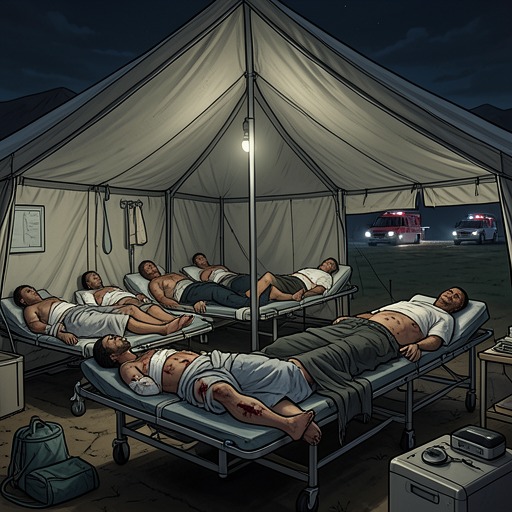
Memorial’s disaster-time patient triage and evacuation priority decisions
Five Days at MemorialMemorial’s disaster-time patient triage and evacuation priority decisions determined how patients were classified and who would leave first during a crisis in which safe transport was scarce. The most consequential exception placed patients with do-not-resuscitate orders last—not because those orders meant that treatment should be withdrawn, but because hospital leaders treated them as evidence that those patients had less to lose. The episode joined a technical problem of moving patients to a larger question of how emergency rules distribute risk when ordinary care and coordination fail.
Background and Constraints
New Orleans’s evacuation began amid major gaps in transportation. Many residents had no car or other way to leave, the city’s plans to move them lacked enough drivers, and traffic already trapped people on the interstate. The New Orleans Superdome was designated a shelter of last resort, but officials did not explain what assistance people with medical needs could expect there. Acadian dispatchers faced calls to move patients from hospitals, nursing homes, and homes; many of the roughly two dozen ambulances made available were stuck in traffic, and some began taking patients to the Superdome rather than out of the city.
The broader emergency had been anticipated without a workable plan for moving the people most dependent on medical care. A recent Hurricane Pam exercise had assumed that more than 2,000 hospital patients would be in New Orleans during a catastrophic hurricane, yet officials had not determined how to get so many patients to safety through floodwaters. In later assessments, the crisis was attributed not to a single choice but to interacting failures: delayed evacuation, insufficient buses and drivers, uncoordinated rescue efforts, poor communications, and hospitals and nursing homes that had not evacuated in advance or equipped themselves with sufficiently robust backup power and water.
The DNR-Last Exception
At Memorial, doctors established an exception to the usual effort to prioritize the sickest patients and those dependent on machines: all patients with DNR orders would be evacuated last. There were four such patients in the intensive care unit, including Helen Breckenridge and Jannie Burgess. During Breckenridge’s transfer downstairs, a doctor ordered that she be taken back up because she could not go in the first group. The rule thus converted a medical designation into an evacuation ranking at the moment when being moved could determine a patient’s access to safety.
A DNR order had a specific and limited meaning: if a patient’s heartbeat or breathing stopped, the patient should not be revived. It was ordinarily signed with the informed consent of the patient or a health-care proxy. It was not the same as a living will, which under Louisiana law allowed a person with a terminal and irreversible condition to request in advance that life-sustaining procedures be withheld or withdrawn. Richard Deichmann later explained that he thought the law required DNR patients to have a certified terminal or irreversible condition. On that understanding, he believed they had the least to lose if disaster struck. The distinction matters: the evacuation rule relied on a mistaken conflation of a limit on resuscitation with a broader judgment about prognosis and treatment.
The patients affected by the rule also carried histories that the category could not express. Jannie Burgess had worked for thirty-five years as a licensed practical nurse, after taking up nursing to support her children. Because of racial segregation, she had been able to care for patients in private hospitals while being barred from receiving care at many of them; although she was born shortly after Memorial opened as Southern Baptist Hospital in 1926, more than four decades passed before she could be a patient there. Her presence among the DNR patients placed last made the impersonal label part of a longer history of unequal access to care.
Triage in Practice
The evacuation classifications were not a single, consistently applied system. A nurse might write 1, 2, or 3, but some doctors later recalled using a fourth category for DNR patients, separating them from other very seriously ill patients classified as 3. Patients could be triaged on their wards before being brought downstairs and reassessed later; the ad hoc systems were similar but not identical. These variations show that the categories were not simply a stable clinical measure. They were improvised tools for sorting patients during a rapidly changing emergency.
As evacuation continued by boat, the strategy shifted: only patients well enough to be discharged were put aboard. Doctors oversaw loading from the emergency-room ramp, while employees and patients’ relatives were also allowed to leave. Meanwhile, patients classified as 1 from Memorial and LifeCare had been brought down in anticipation of rescue and waited in wheelchairs along the sloping sides of the ambulance ramp. Karen Wynn tried to remember each patient’s face so that no one would be lost in the crowd. The waiting area made the limits of classification visible: a number could establish a place in a process, but it could not guarantee when a particular person would be reached.
The strain also narrowed attention beyond the hospital. A woman arrived through floodwater for a regularly scheduled chemotherapy appointment, unaware that the hospital could not provide it. Wynn later described how she and others failed to grasp the extent of the crisis outside Memorial, even as they confronted its severity inside. The account places the triage decisions within a wider breakdown of shared information and perspective, not just a shortage of beds or vehicles.
Consequences and Ethical Significance
The book situates the hospital’s choices within a disaster that killed more than a thousand people immediately in New Orleans, many of them poor, elderly, or in medical facilities; others suffered or died later amid stress and disrupted health care. It also emphasizes that responsibility was distributed across institutions and levels of government. The DNR-last rule was one local decision within failures of evacuation planning, transportation, communications, infrastructure, and rescue coordination. That context helps explain the pressures under which staff acted without making the rule’s underlying misunderstanding disappear.
The aftermath endured for the people who worked through the evacuation. Gina Isbell described nightmares in which she saw her patients’ faces, poor sleep, and guilt about the staff she had scheduled and the patients who died; she had also lost her home and community in St. Bernard Parish. Karen Wynn, preparing for possible grand-jury testimony, found that discussing the events could make her feel as if she were reliving them, and she recognized trauma symptoms in herself and colleagues. These accounts do not assign those consequences to one triage decision, but they show how the emergency’s improvised judgments and unresolved responsibility continued well beyond the evacuation itself.
The central ethical tension is therefore not reducible to whether triage was necessary: evacuation capacity was plainly constrained, and staff were forced to make choices. It lies in how a narrow medical instruction became a proxy for a patient’s overall prospects, and how inconsistent categories shaped access to rescue without resolving the moral uncertainty they carried. The episode exposes the danger of treating a classification as a complete account of a person, especially when the system applying it has not established a reliable, shared basis for doing so.